
- Fits in the box 30
- Article 4550309036751
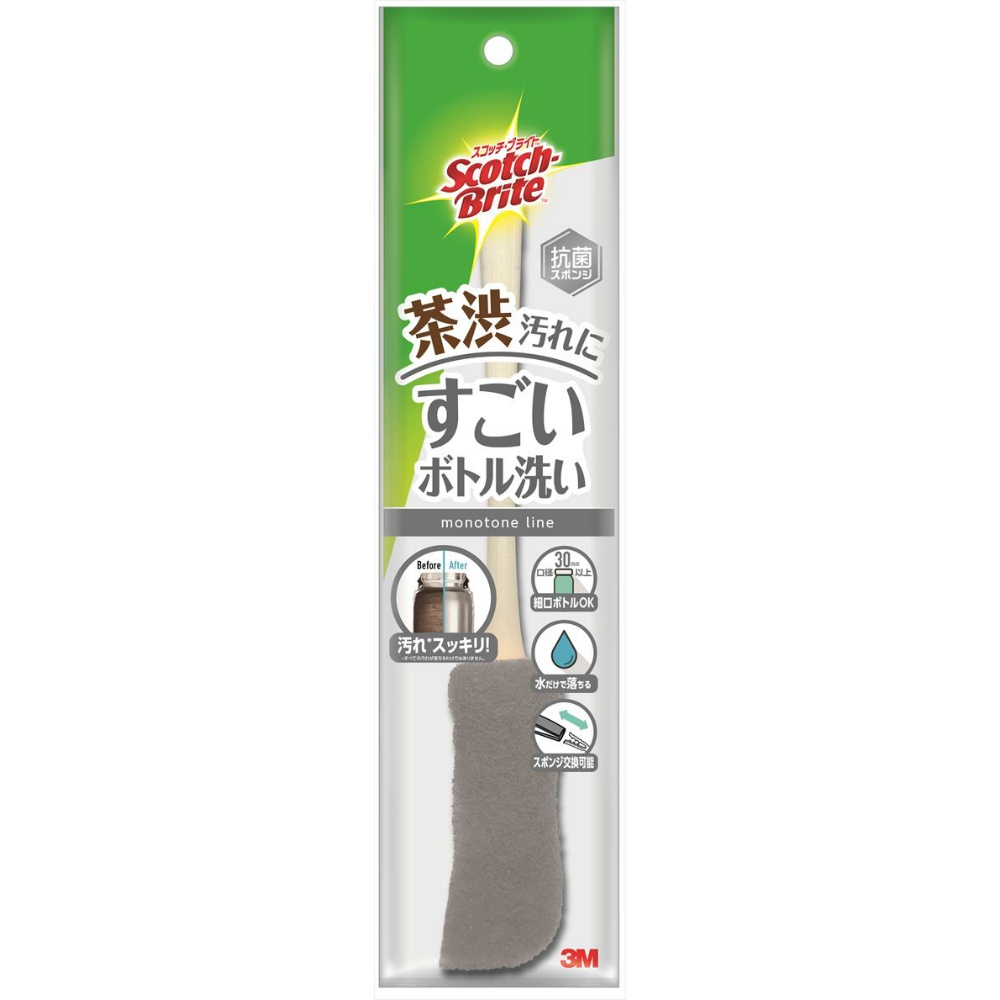
Removes tea stains and discolored stains from bottles
This hybrid three-layer sponge removes tea stains and other stains.
Manufacturer: 3M Japan
[Ingredients] Sponge: Nylon nonwoven fabric (with abrasive particles), urethane sponge (uses inorganic antibacterial agent), Handle: Polypropylene
Precautions for Use: ●Do not use for any purpose other than intended. ●Forcing the sponge into or out of a bottle that is narrower than the sponge may result in injury or damage. Do not use if damaged. ●Shaking the handle may result in injury or damage. ●Do not use chlorine bleach. ●Plastic parts and the exterior of the bottle may be scratched, so test first on an inconspicuous area. ●Rubbing too hard may cause scratches. ●Wash with water before first use. ●Always wet the sponge before use. ●Always use kitchen detergent. ●Do not wring the sponge so that it twists off. ●Do not sterilize by boiling. ●When disposing of, treat it as plastic waste according to the method specified by your local government. *Do not use on PET bottles for beverages. *Do not use on bottles with narrow necks (inner diameter less than 30mm). Sponge: Nylon non-woven fabric (with abrasive particles), urethane sponge (with inorganic antibacterial agent). Handle: Polypropylene. (How to Remove the Sponge) 1. Be sure to wet the entire sponge with water. *Wetting will make it easier to remove. 2. Firmly hold the sponge with one hand, and with the other, move the handle back and forth while pulling it off the sponge. *Pulling too hard may tear it. 3. Make sure the tip of the sponge claw does not catch on the sponge, then slowly remove the sponge from the handle. *Be careful not to tear the sponge. (How to attach the sponge) 1. Wet the sponge with water. *Wetting it will make it easier to attach. 2. Slightly open one side of the handle with your fingers. To make it easier to insert into the handle, crush the yellow part of the sponge with your fingers and pinch it between the forked part of the handle. 3. Slowly insert it until it hits the base of the forked part.
[Usage, Uses, etc.] Precautions for Use: ●Do not use for purposes other than intended. ●Forcing the sponge into or out of a bottle that is narrower than the sponge may result in injury or damage. Do not use if damaged. ●Shaking the handle may result in injury or damage. ●Do not use with chlorine bleach. ● Plastic parts and the exterior of bottles may be scratched, so test first on an inconspicuous area. ● Rubbing too hard may cause scratches. ● Wash with water before first use. ● Always wet the sponge before use. ● Always use kitchen detergent. ● Do not wring the sponge so that it twists off. ● Do not sterilize by boiling. ● When disposing of the sponge, dispose of it as plastic waste according to the method specified by your local government. *Do not use with PET beverage bottles. *Do not use with bottles with narrow necks (inner diameter less than 30 mm). Sponge: Nylon non-woven fabric (with abrasive particles), urethane sponge (with inorganic antibacterial agent), Handle: Polypropylene (How to remove the sponge) 1. Be sure to wet the entire sponge with water. * Wetting the sponge will make it easier to remove. 2. Firmly hold the sponge with one hand, and with the other hand, move the handle back and forth while pulling it off the sponge. * Pulling too hard may tear it. 3. Make sure the tip of the claw does not catch on the sponge, then slowly remove the sponge from the handle. * Be careful not to tear the sponge. (How to attach the sponge) 1. Wet the sponge with water. *Wetting the sponge makes it easier to attach. 2. Slightly open one side of the handle with your fingers. To make it easier to insert into the handle, crush the yellow part of the sponge with your fingers and pinch it between the forked part of the handle. 3. Slowly insert the sponge until it hits the base of the forked part.
[Usage Precautions] Precautions for Use: ● Do not use for any purpose other than intended. ● Forcing the sponge into or out of a bottle that is narrower than the sponge may cause injury or damage. Do not use if damaged. ● Shaking the handle may cause injury or damage. ● Do not use chlorine bleach. ● Plastic parts and the outside of bottles may be scratched, so test first on an inconspicuous area. ● Rubbing too hard may cause scratches. ● Wash with water before using for the first time. ● Always wet the sponge before use. ● Always use kitchen detergent. ● Do not wring the sponge by twisting it off. ● Do not sterilize by boiling. ● When disposing of the sponge, treat it as plastic waste according to the method specified by your local government. *Do not use with plastic beverage bottles. *Do not use with bottles with narrow necks (inner diameter less than 30mm). Sponge: Nylon non-woven fabric (with abrasive particles), urethane sponge (with inorganic antibacterial agent), Handle: Polypropylene (How to remove the sponge) 1. Be sure to wet the entire sponge with water. *Wetting it will make it easier to remove. 2. Firmly hold the sponge part with one hand, and with the other hand, move the handle part back and forth while pulling it off the sponge. *Pulling it out too hard may tear it. 3. Make sure the tip of the claw does not catch on the sponge, then slowly remove the sponge from the handle. *Be careful not to tear the sponge. (How to attach the sponge) 1. Wet the sponge with water. *Wetting it will make it easier to attach. 2. Slightly open one side of the handle with your fingers. To make it easier to insert into the handle, crush the yellow part of the sponge with your fingers and pinch it between the forked part of the handle. 3. Continue inserting it slowly until it hits the base of the forked part. [Storage method] * After use, rinse, drain and dry. * Keep away from fire. * Keep out of reach of infants and young children.
Made in: Japan
- Fits in the box 30
- Article 4550309036751
- Gross weight (box) 1.299 kg
- Gross volume per box 0.017325 m³